Affiliate disclosure: This guide contains one affiliate link, to RAVPower. If you buy through it, we may earn a commission at no extra cost to you. It does not change what we write: the rules below come from the TSA, the FAA and the airlines themselves. See our Affiliate Disclosure.
How this guide was written: It was researched with AI assistance from the official pages listed under Sources, and every rule was checked against those pages on September 29, 2026. We did not test any power bank. These are US rules; other countries and airlines differ. See how we research.
Short answer: Yes. Power banks are allowed on US flights, but only in your carry-on bag, never in checked luggage. The FAA’s standard limit is 100 watt-hours (Wh) per battery, which is roughly 27,000 mAh. Airlines add their own limits: Southwest allows one power bank per customer, while United, American and Delta allow two.
Key takeaways
- Carry-on only. The TSA and FAA both say spare lithium batteries, including power banks, are not allowed in checked bags. If your carry-on is checked at the gate, take the power bank out and keep it with you.
- 100 Wh is the standard ceiling. Convert with mAh × 3.7 ÷ 1,000. A 10,000 mAh power bank is about 37 Wh and a 20,000 mAh one is about 74 Wh.
- Your airline sets the count. Southwest allows one power bank. United, American and Delta allow two.
- In the cabin, keep it out of the overhead bin and do not recharge the power bank from the seat outlet.
The TSA and FAA rules
The TSA’s power bank page says portable chargers containing a lithium-ion battery must be packed in carry-on bags, and that spare lithium batteries, which includes power banks and phone chargers, are prohibited in checked luggage. It does not list a watt-hour limit and points travelers to FAA guidance. The page was last updated on May 14, 2025.
The FAA’s PackSafe page (last updated August 11, 2026) sets the size limits:
- Lithium-ion batteries rated up to 100 Wh each are allowed in carry-on baggage, and the FAA sets no quantity limit for them as long as they are for your own use.
- With airline approval, you may also carry up to two spare batteries above 100 Wh and up to 160 Wh. The TSA’s page on larger lithium batteries says the same.
- Battery terminals must be protected from short circuits, for example by leaving the battery in its retail packaging, taping over the terminals, or using a case or pouch.
- Damaged or recalled batteries must not be carried aboard.
The FAA also warns that many airlines set stricter quantity and watt-hour limits than the federal minimum, so your airline’s own rule is the one that counts on the day.
Airline rules compared (checked September 29, 2026)
This table summarizes what each airline’s own page said when we checked it. Airlines change these rules, so confirm on your airline’s page before you fly.
| Airline | Power banks allowed | Size limit | Overhead bin | Recharging |
|---|---|---|---|---|
| United | Up to two portable chargers | 100 Wh; up to two larger batteries (100–160 Wh) may go in carry-on | Not allowed | Do not recharge from aircraft power |
| American | Up to two portable chargers | 100 Wh each | Not allowed | Do not use seat power to recharge the charger |
| Delta | No more than two power banks | 100 Wh each, with no exceptions | Not allowed | Not recharged on board; not used to charge devices during taxi, takeoff and landing |
| Southwest | One power bank per customer (since April 20, 2026) | 100 Wh | Not allowed | Not charged from in-seat power; visible when in use |
United and American label their portable charger rules as new on their pages. Delta’s page shows no date. Sources for each row are listed at the end of this guide.
How to check your power bank’s watt-hours
Newer lithium-ion batteries usually print the Wh rating on the label, according to the FAA. Use that number when you find it.
If the label only shows mAh, the airlines explain the math. American’s page gives the formula Wh = mAh × 3.7 ÷ 1,000 and uses 3.7 volts in its example. United and the FAA describe the same idea: multiply volts by amp-hours, and divide milliamp-hours by 1,000 to get amp-hours. The table below uses 3.7 volts.
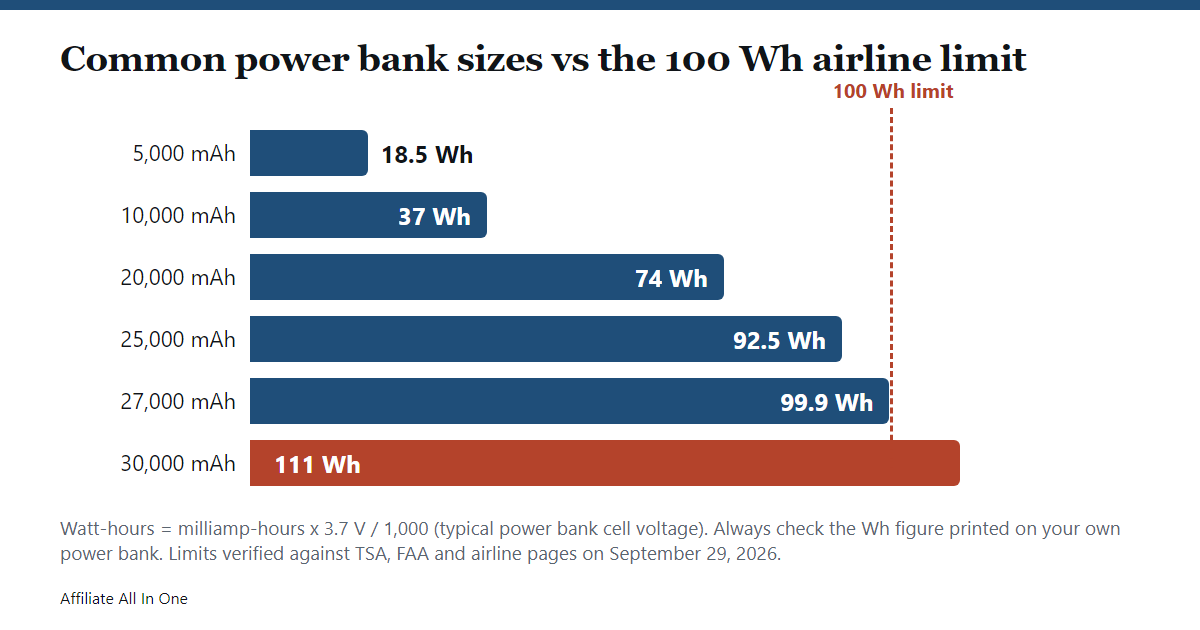
| Capacity on the label | Watt-hours at 3.7 V | Under 100 Wh? |
|---|---|---|
| 5,000 mAh | 18.5 Wh | Yes |
| 10,000 mAh | 37 Wh | Yes |
| 20,000 mAh | 74 Wh | Yes |
| 25,000 mAh | 92.5 Wh | Yes |
| 27,000 mAh | 99.9 Wh | Yes, just under |
| 30,000 mAh | 111 Wh | No |
A 100 Wh limit works out to about 27,027 mAh at 3.7 volts. If your power bank’s label lists a different voltage, use the label; this table is only a guide.
Using a power bank on the plane
- Keep it where you can see it. American and Southwest say to keep it visible while in use. United says to keep it on you or in your personal item. Delta says to store it somewhere easy to reach, such as under the seat in front of you or in the seatback pocket.
- Not in the overhead bin. All four airlines above say so.
- Do not recharge the power bank from the seat. United, American and Southwest say not to use aircraft or in-seat power to recharge it, and Delta says it must not be recharged on board.
- Delta’s takeoff rule. Delta says a power bank must not be used to charge a device during taxi, takeoff and landing.
- Tell the crew if it misbehaves. The FAA says to notify the flight crew immediately if a battery or device is overheating, expanding, smoking or burning.
Larger batteries and portable power stations
Between 100 Wh and 160 Wh, the FAA and TSA require airline approval and allow two spare batteries per person. United’s own page allows up to two batteries in that range in carry-on. American, Delta and Southwest cap power banks at 100 Wh each on their pages.
American’s page also says large portable power banks and lithium-ion powered generators are not allowed as carry-on or checked items, and its examples include brands such as Bluetti, EcoFlow, Jackery and Vevor. Anything above 160 Wh is outside the sizes the FAA page allows, even with airline approval. If you are unsure about a battery, contact your airline before you go.
If you need a power bank under the limit
Most everyday power banks sit well under 100 Wh. For example, RAVPower’s official store lists power banks from 5,000 mAh to 20,000 mAh, and at 3.7 volts a 20,000 mAh model works out to about 74 Wh. Capacity varies by model, so check the rating printed on the product before you fly. We have not tested these products. See RAVPower’s power banks on its official store.
Frequently Asked Questions
Can I put a power bank in my checked bag?
No. The TSA and the FAA both say power banks and other spare lithium batteries must go in carry-on baggage only. If your carry-on is checked at the gate, remove the power bank first and keep it with you in the cabin.
How many mAh is 100 Wh?
About 27,000 mAh at 3.7 volts. Use the Wh rating printed on your power bank if it has one, because it already accounts for the battery’s real voltage.
Can I use my power bank to charge my phone during the flight?
The airline pages we checked allow it if the power bank stays visible and within reach, and not in the overhead bin. Delta says a power bank must not be used to charge a device during taxi, takeoff and landing.
Can I recharge my power bank from the seat outlet?
No. United, American and Southwest say not to recharge a power bank from aircraft or in-seat power, and Delta says it must not be recharged on board. Charge your phone from the outlet instead, if your seat has one.
Are these rules the same outside the United States?
Not necessarily. This guide covers US rules and four US airlines. Other countries and other airlines set their own limits, so check the airline you are flying before you travel.
Sources
All pages were checked on September 29, 2026.
- TSA: Power Banks (last updated May 14, 2025)
- TSA: Lithium batteries over 100 watt hours (last updated March 29, 2023)
- FAA PackSafe: Lithium batteries (last updated August 11, 2026)
- United: Portable chargers, vapes and electronic devices
- American Airlines: Restricted items in bags (Batteries)
- Delta: Battery or fuel powered items
- Southwest: Traveling with lithium batteries, chargers and lighters (power bank limit effective April 20, 2026)
Spotted something out of date? See our corrections policy, or browse more Electronics guides.
Sources and last update
This article is written from official and primary sources, such as government agencies, standards bodies and manufacturer documentation, and is checked against them when it is updated. It is based on research, not hands-on testing. See how we research and our editorial policy.
Last updated: September 29, 2026