How this guide was written: It was researched with AI assistance from U.S. government safety pages, listed under Sources, and checked against them on September 29, 2026. We did not test any power station or generator. This guide has no affiliate links and does not recommend a brand. Safety guidance can change, so the “Updated” date at the top matters. See how we research.
Short answer: A portable power station is a rechargeable battery with outlets. A portable generator burns fuel. The key difference is safety: gas generator exhaust contains carbon monoxide and must be used outdoors, while the EPA says battery-powered units make no toxic fumes and can be used indoors. The EPA also says battery units are often less powerful than gas ones.
Key takeaways
- Carbon monoxide is the deciding safety issue. The CPSC says never to run a portable generator inside a home, garage, basement, crawlspace, shed or other enclosed space.
- Battery units make no fumes. The EPA says they can be used in indoor spaces, though they are often less powerful.
- Distance matters for gas. The CPSC says at least 20 feet from the house, and not on a porch or in a carport.
- Match the unit to what you need to run. Watts tell you what it can power at once, and watt-hours tell you for how long.
Power station vs generator: the differences
| Portable power station | Portable gas generator | |
|---|---|---|
| Energy source | A rechargeable battery, which you recharge before use | Fuel burned in an engine |
| Fumes | EPA: no toxic fumes | Exhaust contains carbon monoxide, which CPSC describes as a poison you cannot see or smell |
| Where it can be used | EPA: indoor spaces, balconies, or near doors, vents and windows | CPSC and EPA: outdoors only, well away from the house |
| Power | EPA: often less powerful, and a practical choice for small appliances, lights and fans | EPA: traditional gas-powered generators are often more powerful than battery units |
| Main hazard | See the maker’s instructions; we did not review any product’s manual | Carbon monoxide poisoning, which CPSC says can incapacitate and kill within minutes |
The first row is the basic definition rather than a government finding, and the “often less powerful” wording comes from the EPA’s power outage page, which was last updated February 18, 2026. Individual products vary widely.
The safety difference: carbon monoxide
The U.S. Consumer Product Safety Commission (CPSC) says its estimate is that about 85 consumers die in the U.S. each year from carbon monoxide poisoning caused by gasoline-powered portable generators. That figure comes from its 2022 announcement and is the annual average for 2017 to 2019, the last three complete years of the report it was based on. We did not find a newer figure we could verify.
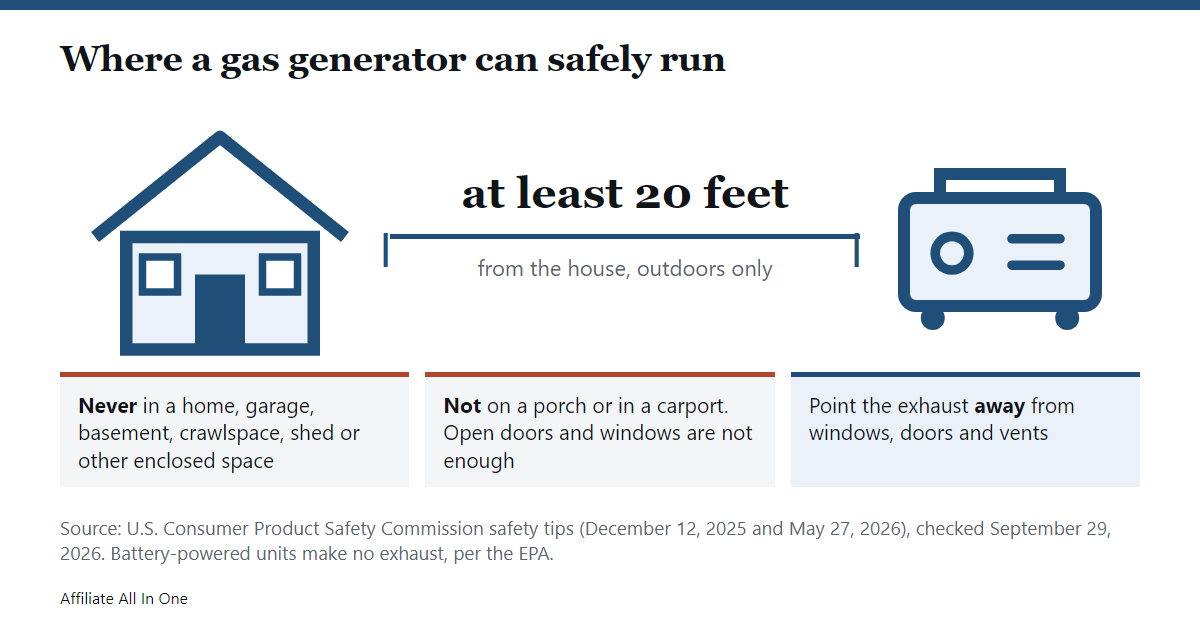
Here is what the CPSC’s safety tips say about gas generators:
- Never operate one inside a home, garage, basement, crawlspace, shed or other enclosed space.
- Opening doors or windows will not provide enough ventilation to prevent the buildup of lethal levels of carbon monoxide.
- Operate it outside only, at least 20 feet from the house, and not on a porch or in a carport.
- Point the exhaust away from your home and any building where someone can enter, including windows, doors and vents.
- Have working carbon monoxide alarms, battery-operated or with battery backup, on every level and outside sleeping areas. If one sounds, get outside immediately and call 911.
- Look for a generator that shuts off automatically when it detects high carbon monoxide levels, which the CPSC recommends.
Our reading: these rules are about where the exhaust can go, not about how careful the user is. That is why the EPA treats battery units, which make no exhaust, differently.
Watts vs watt-hours: how to size either one
Two numbers on any spec sheet decide whether a unit fits your needs:
- Watts (W) is how much power the unit can supply at one moment. Add up the watts of everything you plan to run at once. Spec sheets commonly list a continuous rating and a higher short-term surge rating, so check both.
- Watt-hours (Wh) is how much energy a battery holds. It tells you for how long a power station can run something.
A rough run-time estimate is watt-hours divided by the watts you are drawing. This is our own arithmetic. Real run times are shorter, because power conversion loses some energy, and we did not verify any product’s loss figure. The table uses made-up example numbers, not real products.
| Example battery | Example load | Rough run time (before losses) |
|---|---|---|
| 500 Wh | 50 W | About 10 hours |
| 1,000 Wh | 200 W | About 5 hours |
| 1,000 Wh | 1,000 W | About 1 hour |
| 2,000 Wh | 500 W | About 4 hours |
A gas generator is sized in watts, and how long it runs depends on how much fuel it holds, so the arithmetic above applies only to batteries.
Which one fits which situation
This is our own reading of the sources above, not an official recommendation.
- Small loads, such as phones, lights and a laptop: a power station fits, and the EPA’s indoor-use statement removes the carbon monoxide concern.
- Larger loads: the EPA says battery units are often less powerful, so check a specific unit’s watt rating against what you need to run.
- Anywhere you cannot put a gas generator at least 20 feet from the house: a battery unit avoids the exhaust problem, according to the EPA’s indoor-use statement.
What to check before you buy either
- List what you would run at once and add up the watts. Compare that total with the unit’s continuous rating.
- For a power station, check the watt-hours. That sets how long it can run your load.
- For a gas generator, check for a carbon monoxide shutoff. The CPSC recommends one.
- Read the manufacturer’s instructions on where and how to use it. We have not reviewed any product’s manual.
- Buy carbon monoxide alarms either way. The CPSC recommends them on every level of the home.
Frequently Asked Questions
Can I use a portable power station indoors?
The EPA says battery-powered generators do not generate toxic fumes, so they can be used in indoor spaces, on balconies, or near doors, vents and windows. Follow the maker’s instructions for your specific unit, which we have not reviewed.
Can I run a gas generator in my garage with the door open?
No. The CPSC says never to operate a portable generator in a garage or other enclosed space, and that opening doors or windows will not provide enough ventilation to prevent lethal carbon monoxide levels.
How far from the house should a gas generator be?
The CPSC says at least 20 feet from the house, with the exhaust directed away from windows, doors and vents. It also says not to use one on a porch or in a carport.
Is a power station or a generator better for a power outage?
It depends on what you need to run. The EPA says battery units are often less powerful than gas ones, and it calls them a practical choice for small appliances, lights and fans. Check a unit’s watt rating against the total you need before choosing.
Do I need a carbon monoxide alarm if I use a battery power station?
The CPSC’s outage safety tips call for working carbon monoxide alarms on every level of the home and outside sleeping areas. Its generator page also notes that charcoal grills produce carbon monoxide too.
Sources
All pages were checked on September 29, 2026.
- EPA: Power outages and indoor air quality (last updated February 18, 2026)
- CPSC: Winter storm safety tips to prevent carbon monoxide poisoning and fires (December 12, 2025)
- CPSC: Generator, carbon monoxide and fire hazards ahead of hurricane season (May 27, 2026)
- CPSC: New report on carbon monoxide fatalities and generator safety (August 4, 2022)
- CPSC: Generators and engine-driven tools
Spotted something out of date? See our corrections policy, or browse more Electronics guides.
Sources and last update
This article is written from official and primary sources, such as government agencies, standards bodies and manufacturer documentation, and is checked against them when it is updated. It is based on research, not hands-on testing. See how we research and our editorial policy.
Last updated: October 7, 2026