How this guide was written: It was researched with AI assistance from the Connectivity Standards Alliance, Apple, Google and Amazon documentation and one lock maker’s product pages, listed under Sources, and checked against them on September 30, 2026. We did not test any lock. We use Lockin as the worked example because its pages are public; other makers differ. This guide has no affiliate links and does not recommend a brand. See how we research.
Short answer: A Matter smart lock can be added to Apple Home, Google Home, Alexa and other Matter apps, not just its maker’s app. It connects over Wi-Fi or Thread, and control from away from home needs a hub or smart speaker in the house. Matter does not guarantee every feature: Google, for example, disables remote unlock for Matter locks that do not require a PIN.
Key takeaways
- Door locks are an official Matter category. The Connectivity Standards Alliance (CSA), which runs Matter, lists door locks among the device types Matter supports.
- Matter is local. The CSA says Matter-only devices need an internet-connected controller in the home, such as a hub or smart speaker, for control when you are away.
- Each platform has its own rules for locks. Their own documentation differs on hubs, Thread and remote or voice unlock.
- A maker’s claims need reading closely. One Lockin page itself says built-in Wi-Fi does not remove ecosystem hardware requirements.
What Matter changes for a lock
Before Matter, most smart locks worked mainly through their own app and cloud service. The CSA describes Matter as an open smart home protocol that uses Bluetooth Low Energy for setup and Wi-Fi, Thread or Ethernet for connecting devices. Its multi-admin feature lets you connect one device to several platforms and choose which can access it. The CSA also says adding Matter lets products use a local connection for greater reliability and responsiveness.
The CSA adds that many Matter devices still come with a vendor app “that offers advanced configuration and differentiated features”. For a lock, that means basics such as locking and unlocking may work in any Matter app, while extras can stay in the maker’s own app. Look for the Matter badge, the CSA advises.
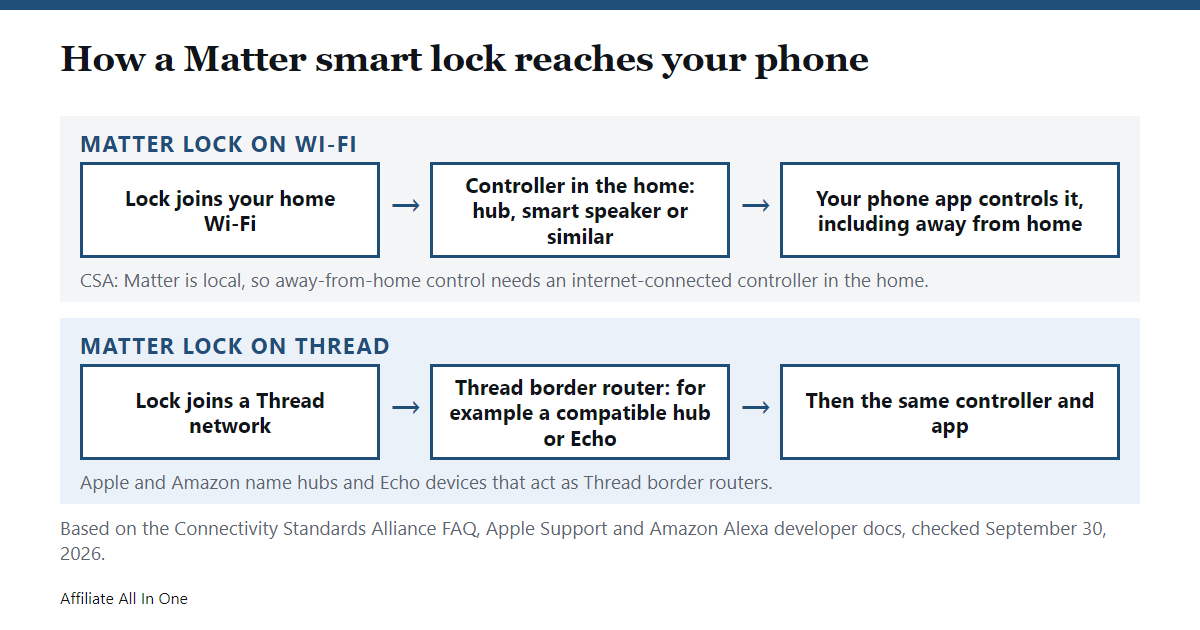
Wi-Fi or Thread: what each needs
A Matter lock connects over Wi-Fi or over Thread, a separate wireless network technology. A Thread lock needs a Thread border router, and several everyday devices act as one. A Wi-Fi lock joins your router directly. Lockin’s Veno pages that we read mention built-in Wi-Fi and Matter but do not say which one Matter runs over, so check the model’s setup guide.
What each platform says about locks
| Platform | What its own documentation says | Page date |
|---|---|---|
| Apple Home | The Home app supports Matter locks. With iOS 18 or later you can add Matter accessories without a home hub. iPhone 15 Pro and later can control Thread accessories without a hub, though Apple advises a home hub for the best experience. Thread accessories otherwise need a Thread-enabled hub such as an Apple TV 4K, HomePod (2nd generation) or HomePod mini, or a compatible third-party Thread border router. | Published May 7, 2026 |
| Google Home | Lists a Door Lock device type. Says the Matter specification does not require PIN codes for door locks, but remote unlock is disabled for Matter door locks in Google’s ecosystem that do not mandate a PIN, and voice unlock for door locks is also disabled. | Last updated December 20, 2024 |
| Amazon Alexa | Supports closure devices including door locks. Thread-enabled Echo and eero devices have built-in Thread border routers. | Last updated May 1, 2026 |
SmartThings is also named by lock makers, but its support pages blocked our access, so we cannot report what it says. Google’s page is the oldest of the three, so check it for current rules before you buy.
Away from home, and unlocking safely
The CSA says Matter is a local connectivity technology, so Matter-only devices need an internet-connected controller in the home to be controlled away from it. It adds that most controllers offer an app or web interface, and that some Matter devices also connect directly to the internet, so the maker’s own app can control them from outside the home. In our reading, that second route is what a lock’s “built-in Wi-Fi, no hub required” wording describes. A lock that shows “Matter” is not automatically reachable from the street through other platforms: that needs a controller.
Unlocking is the sensitive action, and platforms treat it differently. Under Google’s rules, remote and voice unlock depend on the lock requiring a PIN. Lockin’s Veno Go page lists voice as a “Matter-enabled” unlock method, and its Veno Solar Palm page lists voice control among five ways to unlock. Neither page says which platforms allow voice unlock, and we did not test any. Check the rule for the platform you use.
Reading a maker’s Matter claims
Lockin’s product pages show the fine print worth looking for. All are the maker’s statements, not our testing:
- Veno Solar Palm: built-in Wi-Fi to lock, unlock and manage access remotely with no hub required, and Matter compatibility with Apple Home, Alexa, Google Home and SmartThings.
- Veno Go: built-in Wi-Fi for the Lockin app and Matter for other platforms, with a note that ecosystem hub and controller requirements are in the Lockin FAQ and model instructions, and that built-in Wi-Fi does not remove ecosystem hardware requirements.
- Battery: up to 7 months on the Veno Go and Veno Palm Vein pages, with low-battery alerts and emergency power-bank or key access. The Veno Solar Palm page describes solar self-charging.
- Security grade: ANSI Grade 3 on the Veno Solar Palm and Veno Go pages and BHMA Grade 2 on the Veno Palm Vein page. We did not review the grading standard.
The pages list features such as palm vein unlock and one-time PIN codes, but they do not say which of them are available through Matter rather than only in Lockin’s app. That is the question to ask.
How to check whether a lock is Matter-certified
Shoppers often search by brand, for example “Yale smart lock with Matter”. A brand name does not tell you whether a particular model is certified, because makers sell many models and add new ones over time. The Connectivity Standards Alliance runs a public Certified Products search. Its page says the listed end products are tested for conformance to an Alliance standard, and its Device Type filter includes “Door Lock” and “Door Lock Controller”. Our reading of how to use it:
- Open the CSA’s Certified Products search and filter the device type to Door Lock.
- Look for your exact model and confirm the entry is for Matter, since the same database also covers other Alliance standards such as Zigbee.
- Then read the maker’s page and your platform’s lock rules above. A certified listing does not tell you which features reach your platform, such as voice unlock or app-only features.
We did not search the database or check any particular brand’s lock for this guide, so we name no brand beyond the worked example above.
What to check before you buy
- The Matter badge. The CSA says to look for it on devices and controllers.
- Your platform’s rules for locks. Read the Apple, Google or Alexa page above for the platform you use.
- Wi-Fi or Thread. If Thread, confirm you have a border router. Apple and Amazon name compatible devices.
- How you will reach it away from home. Confirm which hub, speaker or app does that.
- Which features need the maker’s app. Ask which are available through Matter.
- Power and backup. Check the stated battery life, low-battery alerts and emergency access such as a key or power bank.
Frequently Asked Questions
Do I need a hub for a Matter smart lock?
It depends on the lock and platform. Apple says iOS 18 or later can add Matter accessories without a home hub, but Thread accessories otherwise need a Thread-enabled hub. The CSA says an internet-connected controller in the home is needed for control away from home.
Which smart locks support Matter?
There is no single fixed list, because makers keep adding certified models. Use the CSA’s Certified Products search, filtered to the Door Lock device type, to check a specific model, then read the maker’s page and your platform’s rules for locks. We did not check any particular brand.
Can I unlock a Matter lock with my voice?
Google’s page says voice unlock for door locks is disabled. Lockin lists voice as a Matter-enabled method on some models. We did not test either, so check the rule for your platform and model.
Can a Matter lock work with more than one app?
Yes. The CSA’s multi-admin feature lets you connect a Matter device to several platforms and choose which can access it.
Is Thread better than Wi-Fi for a smart lock?
The sources we read do not rank them. Thread needs a border router, and Wi-Fi joins your router directly. Choose based on the hardware you already have.
Will a Matter lock work if the internet goes down?
The CSA calls Matter a local connectivity technology, which points to local control staying possible. Whether a given lock’s features work without internet depends on the lock, so check its documentation.
Sources
All pages were checked on September 30, 2026, except the CSA Certified Products page, checked on October 1, 2026.
- Connectivity Standards Alliance: Matter FAQ
- Connectivity Standards Alliance: Certified Products search
- Apple Support: Pair and manage your Matter accessories (published May 7, 2026)
- Google Home Developers: Supported Matter devices (last updated December 20, 2024)
- Amazon Alexa: Connect Your Device to Alexa with Matter (last updated May 1, 2026)
- Amazon Alexa: Understand Smart Home Thread Support (last updated May 1, 2026)
- Lockin: Veno Solar Palm
- Lockin: Veno Go Palm Vein Smart Lock
- Lockin: Veno Palm Vein Recognition Smart Lock
Spotted something out of date? See our corrections policy, or browse more Electronics guides.
Sources and last update
This article is written from official and primary sources, such as government agencies, standards bodies and manufacturer documentation, and is checked against them when it is updated. It is based on research, not hands-on testing. See how we research and our editorial policy.
Last updated: October 12, 2026