How this guide was written: It was researched with AI assistance from the support pages of three solar camera makers and NREL’s PVWatts calculator, listed under Sources, and checked against them on September 30, 2026. The sun figures were calculated by us from NREL’s data. We did not test any camera or panel. This guide has no affiliate links and does not recommend a brand. See how we research.
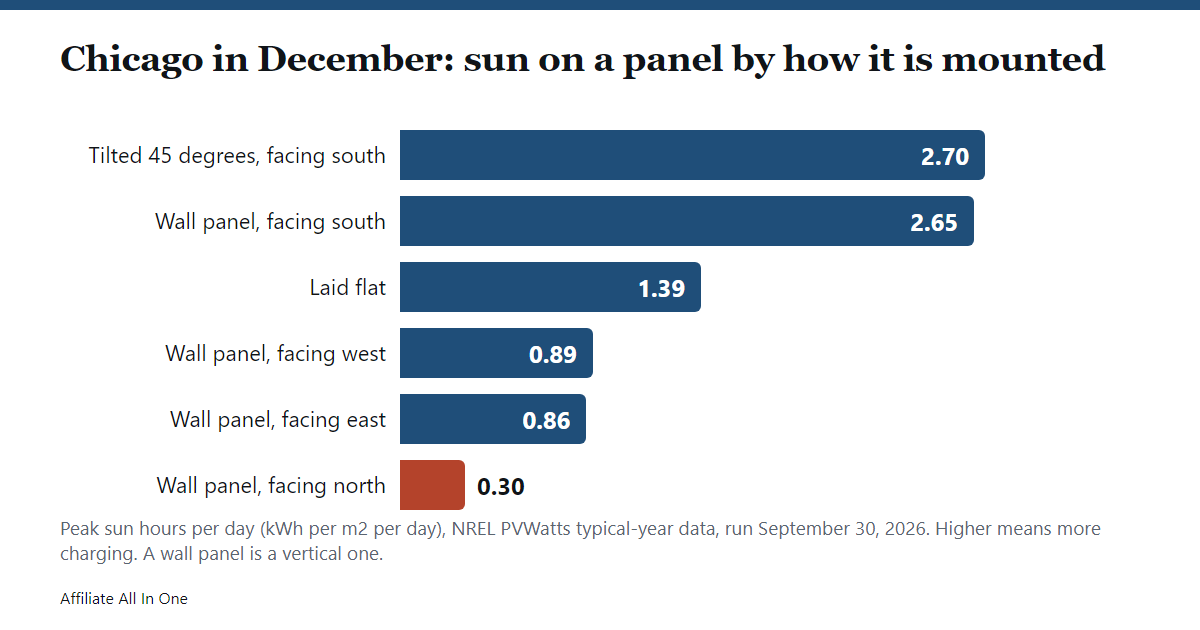
Short answer: Makers ask for “a few hours” of direct sun a day (Ring) or 1 to 2 hours (Eufy), and Reolink and Eufy list a 0°C (32°F) minimum for charging. Direction matters most in winter. In our NREL-based figures for Chicago in December, a south-facing wall panel gets 2.65 peak sun hours, an east or west one about 0.9, and a north one 0.30.
Key takeaways
- Makers ask for direct sun, not just daylight. Ring, Eufy and Reolink all say the panel needs direct sunlight, and Reolink says LED light and moonlight do not work.
- Winter is the limit. Reolink says shorter days and lower sun angles reduce output in winter, and Eufy and Reolink list 0°C as the lowest temperature for charging most of their panels.
- A south-facing wall works nearly as well as an ideal tilt in winter. In Seattle, Chicago and Denver in December, our wall-panel figures are within 2% of a 45 degree tilt.
- A north-facing panel is the worst spot. In December it gets 8% to 16% of what a south-facing wall panel gets in our five cities.
What the makers say
Three makers publish setup advice for their solar panels. Their pages give different levels of detail, and none gives the camera’s daily power use, so no page lets you calculate a guaranteed sun requirement. All entries are the makers’ statements, not our testing.
| Maker | Sun requirement | Placement and angle | Other notes |
|---|---|---|---|
| Ring | A few hours of direct sunlight per day keeps the camera charged | On a wall or roof where it gets at least a few hours of sun; watch for shadows from branches; the mounting arm can be aimed | Original panel is 2 W and the Super Solar Panel is 5 W, described as useful with more cloud cover or faster battery drain. Ring’s pages differ on clouds: one says the panel works fine on cloudy days, others say direct sunlight is required and filtered sunlight through clouds will not charge |
| Eufy | 1 to 2 hours of direct sunlight every day keeps a eufyCam charged around the clock | Make sure the panel receives direct sunlight; one panel per camera | Output is 5 V and up to 500 mA depending on sunlight. Charging temperature is 0 to 45°C, and outside that range the camera cannot be charged. Cloudy and rainy days can drain the battery, and a sunny 1 to 2 hours can recharge it. Solar charging does not allow continuous recording |
| Reolink | Direct sunlight is required; the pages we read give no hours figure | Avoid shade from trees, buildings or eaves; face due south in the northern hemisphere; ideal tilt is latitude plus 5 degrees, and 40 to 45 degrees works well year-round; do not install fully horizontal | Panels come in 3 W, 6 W and 12 W. The 3 W, 6 W and 12 W panels charge between 0 and 45°C, so the camera is not charged below 0°C; the 2S panel can recharge at lower temperatures. High camera power use can outrun the panel |
Hours of direct sun are not peak sun hours
The makers’ figures count hours when the sun shines directly on the panel. NREL’s tools report something different: the energy that reaches the panel each day, expressed as “peak sun hours” (1 kWh per square meter equals one hour of full-strength sun, which is our conversion). The two cannot be swapped for each other, so we do not use NREL’s numbers to check a maker’s hours. We use them to compare places, seasons and mounting directions, which is where installers can actually choose. Our solar generator guide explains the sun-hours idea in more detail.
Which way the panel faces
Many solar cameras mount their panels on a wall, which means vertical. We ran NREL’s PVWatts calculator for five cities with a vertical panel facing each compass direction, and compared it with a 45 degree tilt facing south and a panel laid flat. Numbers are peak sun hours per day in December, the worst month.
| City | Wall, facing south | Wall, facing east | Wall, facing west | Wall, facing north | 45° tilt, facing south | Laid flat |
|---|---|---|---|---|---|---|
| Seattle, WA | 1.59 | 0.63 | 0.53 | 0.25 | 1.56 | 0.83 |
| Chicago, IL | 2.65 | 0.86 | 0.89 | 0.30 | 2.70 | 1.39 |
| Denver, CO | 4.61 | 1.54 | 1.36 | 0.39 | 4.70 | 2.31 |
| Phoenix, AZ | 5.38 | 1.97 | 1.83 | 0.53 | 5.81 | 3.18 |
| Miami, FL | 4.20 | 1.92 | 1.76 | 0.63 | 5.06 | 3.42 |
What stands out:
- South is best in winter, and a wall is fine. In Seattle, Chicago and Denver a south-facing wall panel matches a 45 degree tilt in December (Chicago: 2.65 against 2.70). This fits Reolink’s advice that 40 to 45 degrees works well and its advice to face due south.
- East and west walls are weak. In December they get 30% to 46% of a south-facing wall in our five cities.
- North is the trap. A north-facing wall panel gets 8% to 16% of a south-facing one in December. If the only spot for the camera faces north, our reading is that the panel is better mounted elsewhere on a cable, within the makers’ extension limits (Eufy says an extension of no more than 2.5 m, and Reolink advises no more than 9 m of extension cable in total).
- Flat is about half as good as a south wall in winter in Seattle, Chicago and Denver (52%, 52% and 50%), and Reolink adds that flat panels collect debris.
The picture reverses in summer. A south-facing wall panel gives up a lot of sun when the sun is high:
| City | December: wall / 45° tilt | June: wall / 45° tilt | Annual average: wall / 45° tilt |
|---|---|---|---|
| Seattle, WA | 1.59 / 1.56 | 2.42 / 5.10 | 2.58 / 3.87 |
| Chicago, IL | 2.65 / 2.70 | 2.21 / 5.26 | 2.91 / 4.40 |
| Denver, CO | 4.61 / 4.70 | 2.35 / 5.95 | 3.87 / 5.66 |
| Phoenix, AZ | 5.38 / 5.81 | 1.95 / 6.44 | 3.94 / 6.36 |
| Miami, FL | 4.20 / 5.06 | 1.23 / 4.25 | 2.90 / 5.17 |
Over a whole year a south wall gets 56% to 68% of a 45 degree tilt. For a camera that must keep running through the darkest month, December is the number to plan around, and there a wall matches a tilt in the northern cities.
What that means in energy
To turn sun hours into a rough amount of energy, multiply panel watts by sun hours by 0.86. That factor is the 14% default system loss in NREL’s PVWatts version 5 manual, so it is a starting point rather than a measured value for these panels. For a 3 W panel in Chicago in December, our arithmetic gives about 6.8 Wh a day on a south-facing wall and about 0.8 Wh a day on a north-facing wall. Whether either is enough depends on the camera, and none of the makers’ pages we read give a daily figure. Reolink notes that live viewing, continuous recording and frequent motion alerts raise power use and can exceed what the panel supplies.
What to check before you mount it
- Find your December spot. Watch where direct sun lands in winter, when trees and neighboring buildings cast the longest shadows.
- Prefer a south-facing spot. Avoid north, and expect east and west walls to give about a third to under half of a south wall in December.
- Check the cold limit. Eufy and Reolink list 0°C (32°F) as the minimum for charging most of their panels. Compare that with your local winter lows.
- Read the panel’s watts and the camera’s settings. Ring’s larger panel is 5 W against 2 W, and Reolink lists 3 W, 6 W and 12 W. Limit live viewing and alerts if power is tight.
- Keep the panel clean and unshaded. Reolink lists dust, leaves, bird droppings and snow as causes of lower output.
Storage is a separate question; see our guide to security cameras without a subscription.
If your solar camera is not charging
These checks come from the Reolink and eufy support pages listed under Sources, which we re-read on October 1, 2026. They are the makers’ statements, not our testing, and we did not find a charging-problem page from Ring in our reading, so check Ring’s own support if you use one of its cameras.
- Is direct sun reaching the panel? Reolink says its panel needs direct sunlight and cannot charge from indirect light such as LED light or moonlight. Eufy likewise describes direct sunlight.
- Is the panel shaded, flat or facing the wrong way? Reolink advises avoiding shade, facing due south in the northern hemisphere and not mounting the panel fully horizontal.
- Is it too cold? Eufy and Reolink list 0 to 45°C for charging most of their panels.
- Is the cable the problem? Reolink says cables that are too long cause a voltage drop and recommends no more than 9 metres (30 feet) of extension cables in total, and it lists loose or damaged cables and connectors as a cause of poor charging. Eufy says an extension should be no longer than 2.5 metres (8 feet).
- Is the battery inside the camera? Reolink says its panel charges the camera’s battery, so it cannot charge a battery camera that has no battery inside.
- Is the camera using more power than the panel makes? Reolink suggests lowering power-hungry settings while the battery recharges, then restoring them. Eufy says solar charging does not allow continuous recording.
- Is the panel dirty or covered? Reolink lists dust, leaves, bird droppings and snow as causes of lower output.
Frequently Asked Questions
How many hours of sun does a solar security camera need?
Eufy says 1 to 2 hours of direct sunlight a day keeps its eufyCam charged, and Ring says a few hours of direct sunlight a day keeps its cameras charged. The Reolink pages we read give no hours figure. These are hours of direct sun on the panel, not NREL’s peak sun hours.
Do solar security cameras work in winter?
They can, but conditions are harder. Reolink says shorter days and lower sun angles reduce output, and Eufy and Reolink list 0°C as the minimum for charging most of their panels. Our figures show December sun is a fraction of the summer amount, especially on east, west and north walls.
Do solar cameras work on cloudy days?
Makers say reduced sun affects charging. Eufy says cloudy and rainy days can drain the battery and a sunny 1 to 2 hours can recharge it. Ring’s own pages disagree: one says its panel works fine on cloudy days, while others say filtered sunlight through clouds will not charge.
Why is my solar camera not charging?
The makers’ pages point to a short list: no direct sun on the panel, shade or a flat mount, temperatures outside 0 to 45°C, an extension cable that is too long or a loose connector, no battery inside the camera, or the camera using more power than the panel supplies. The section above walks through each one, with the maker’s wording.
Which direction should the solar panel face?
Reolink says due south in the northern hemisphere. Our December figures agree: south is best and north is worst, at 8% to 16% of a south-facing wall in our five cities.
Can I mount the solar panel flat?
Reolink advises against installing a panel fully horizontal, because debris builds up and efficiency drops. In our figures a flat panel gets about half a south wall’s sun in December in Seattle, Chicago and Denver, though more in summer.
Sources
All pages were checked on September 30, 2026, and the Reolink and eufy pages were re-read on October 1, 2026 for the troubleshooting section. Sun figures come from the PVWatts calculator’s typical-year weather data (NSRDB), run by us for each city with a fixed open-rack array.
- Reolink: Understanding and Optimizing Reolink Solar Panel Efficiency
- Reolink: How to Use Solar Panel Effectively
- eufy: Solar Panel Charger FAQ
- eufy: How much electricity can Solar Panels charge eufyCam every day
- Ring: Solar Panel for Stick Up Cam Battery (2nd Gen) Information
- Ring: Learn About Super Solar Panel for Outdoor Cam and Spotlight Cam
- NREL: PVWatts Calculator
- NREL: PVWatts Version 5 Manual (September 4, 2014), for the default 14% system loss
Spotted something out of date? See our corrections policy, or browse more Electronics guides.
Sources and last update
This article is written from official and primary sources, such as government agencies, standards bodies and manufacturer documentation, and is checked against them when it is updated. It is based on research, not hands-on testing. See how we research and our editorial policy.
Last updated: October 13, 2026