This article contains affiliate links. If you buy through them, we may earn a commission at no extra cost to you. This does not influence our research or recommendations. See our Affiliate Disclosure.
How this guide was written: It was researched with AI assistance from Schumacher Electric’s owner’s manual for its SJ1330, SJ1331 and SJ1583 jump starters and its product page for the SJ1330, Clore Automotive’s jump starting guide, two Battery Tender articles on using and maintaining a jump starter, an AAA article on jumping a battery and AAA’s battery test page, the NHTSA tire safety page, the FAA PackSafe page on lithium batteries, and the Battery University article on charging at high and low temperatures, all listed under Sources, and checked against them on October 21, 2026. We did not test or measure any jump starter or compressor. We do not rank products. This guide has no affiliate links. Schumacher, Clore and Battery Tender sell jump starters and AAA sells batteries and memberships, so their pages reflect their own interests. See how we research.
Short answer: A jump starter with an air compressor is one battery pack with two jobs: it sends a short, strong burst of current to start an engine with a weak battery, and it runs a small pump to inflate tires. The pack has to be charged before you need it, and the makers we read disagree on how often to top it up, from every 30 days to every 90 days. For size, use the maker’s engine-size rating for your fuel type rather than the peak amp number alone, because the figures are each maker’s own and vary widely. For tires, inflate to the pressure on your vehicle’s label, not the number on the tire.
Key takeaways
- It is two tools in one case. The jump function is the battery pack with clamps. The compressor is a small pump run from the same pack, so using it drains the same battery.
- Connect red to positive, black to metal. Schumacher, Clore, Battery Tender and AAA all say the last connection goes to bare metal on the engine or frame, away from the battery, not the dead battery’s negative post. Follow your vehicle’s manual if it names a jump point.
- The makers’ limits differ. How long to crank, how long to wait and how often to charge vary by maker and by battery type. Your unit’s manual is the rule for your unit.
- Peak amps are not comparable across makers. None of the maker pages we read explain how their peak or cranking figures are measured. Their own engine-size ratings for similar peak numbers differ a lot.
- The compressor is for short runs. Schumacher’s manual says to let the unit cool and warns against leaving it unattended, and its troubleshooting table says an overheated compressor needs 10 minutes to cool.
- Heat and cold matter. Battery Tender says a lithium pack stored in a very hot car degrades faster, and Battery University says consumer lithium-ion cells should not be charged below freezing.
- Check airline rules before flying with one. The FAA’s lithium page covers spare batteries and power banks, and it does not name jump starters.
What is a jump starter with an air compressor?
A portable jump starter is a battery pack with heavy cables and clamps. It lets you start a vehicle whose own battery is too weak, without a second car. The “with air compressor” versions add a small pump, a hose and a gauge to the same case. Schumacher’s product page for its SJ1330, for example, describes a 4-in-1 device: jump starter, work light, USB and 12-volt power outlet, and an air compressor rated for 150 psi with an automatic thermal shutoff that restarts when the pump cools.
The battery inside is not always the same type. Schumacher’s owner’s manual for the SJ1330 family says the unit contains a sealed lead-acid battery. Battery Tender says modern portable jump starters use lithium-polymer or lithium iron phosphate cells. Both kinds are sold, and the care rules differ, which is why the charging advice below does not agree. This is our reading of the difference. Neither maker says it that way.
The combination matters in practice for one reason: the pump and the starter share a battery. Schumacher’s manual tells you to recharge the unit after using the compressor and before storing it. If you inflate a tire and leave it uncharged, you may have less left for the next jump.
How does a portable jump starter work, and how do you use one?
The pack stores energy and releases it quickly through the clamps. The clamps connect it to the dead battery’s circuit so it can supply the starter motor’s heavy current. Once the engine runs, the alternator takes over the job of recharging the battery. AAA says a jump-start does not equal a charged battery and advises driving without stopping for 20 to 30 minutes, and Battery Tender suggests 30 to 45 minutes at highway speeds. Both are vendor and club guidance, not a measured rule.
The sequence is close to the same across the sources we read:
- Prepare. Turn the ignition off. Check the jump starter’s cables, clamps and case. Clore lists burn marks, damaged clamp springs, exposed copper and a swollen case as reasons not to use it. AAA says not to jump a battery that is cracked, bulging or leaking.
- Check the charge. Schumacher’s unit shows red below 20%, yellow or orange from 20% to 80% and green above 80%. Battery Tender says to confirm at least one bar on its indicator.
- Red clamp to the positive post of the dead battery, usually marked plus or with a red cover.
- Black clamp to bare metal on the engine block or frame, away from the battery. Clore calls a ground connection “best practice” because the dead battery can vent hydrogen, and says a painted surface blocks the electrical path. Schumacher’s manual says the same for a negative-ground vehicle.
- Turn the unit on, if it has a switch, then start the car. Keep cables clear of fans and belts.
- When the engine starts, switch the unit off if it has a switch and remove the clamps in reverse order. Charge the unit.
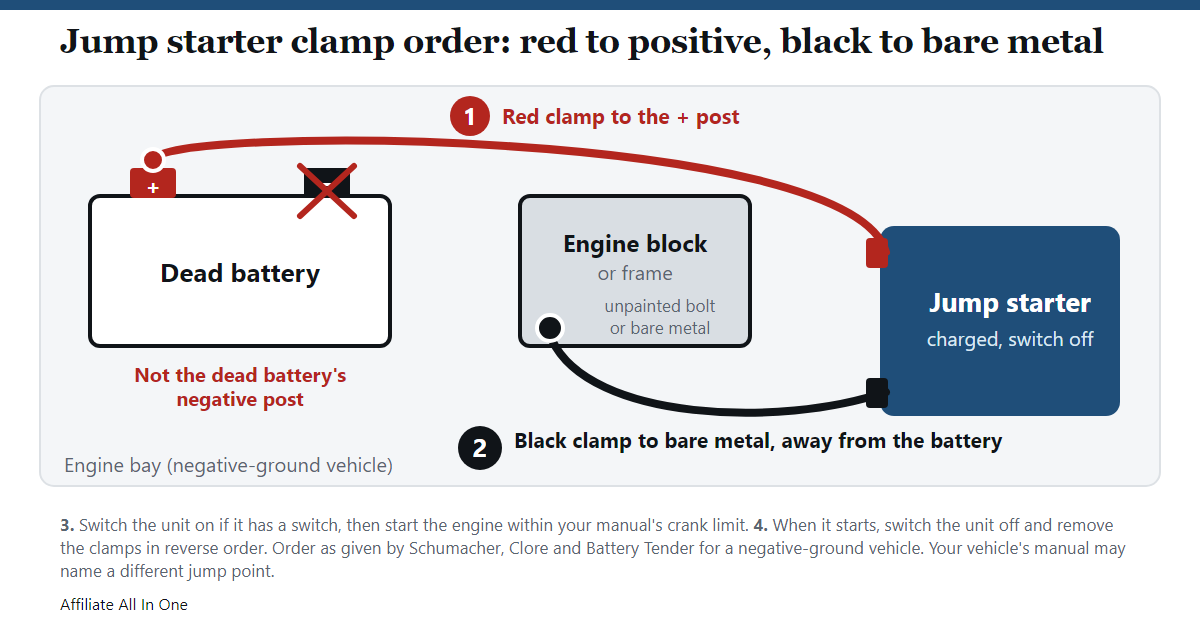
Some vehicles name a specific jump point or have a battery in an unusual place. Battery Tender says some newer vehicles, including those with start-stop systems or AGM batteries, may require specific procedures in the owner’s manual, so read yours before you connect anything.
The makers’ cranking limits are where they diverge:
| Source | Maximum crank time | Wait before the next try | Charge the unit |
|---|---|---|---|
| Schumacher SJ1330 family manual (lead-acid) | 8 seconds | 2 minutes | Immediately after purchase, after every use, and monthly |
| Clore Automotive guide | 6 seconds | 3 minutes | Every 90 days |
| Battery Tender (lithium) | 5 seconds | 30 seconds | Check charge quarterly; store at 50% to 80% |
The table only reports what each source says. Different units and chemistries probably explain part of it, but we cannot tell which, so follow the manual that came with your unit.
How many amps do you need?
Jump starters are sold by amps, but the number on the box can mean different things. Schumacher’s SJ1330 page lists “225A cranking, 1000A peak.” Peak is the short burst at the start, and cranking is a lower figure. AAA calls cold cranking amps, the rating of a car battery, the recognized industry standard for battery power and says to take the correct figure from the owner’s manual. The jump starter makers’ pages we read do not explain how they measure peak or cranking, so we treat those numbers as each maker’s own rating, not a common standard.
What helps more is the engine-size rating, where a maker gives one. Here is what two makers say, which shows the gap:
| Maker and unit | Peak rating | Engine rating given |
|---|---|---|
| Schumacher SJ1330 (product page) | 1000 A peak, 225 A cranking | Up to 8.0 L gas and 6.0 L diesel |
| Battery Tender Charge N Start (article) | 1200 A | Covers most diesel engines up to 3.0 L |
The peak numbers are close, and the engine limits are not. We cannot say why, because the sources do not explain their testing. The practical reading is to compare engine ratings for your fuel type, not peak amps, and to choose a margin above your engine. Battery Tender says a diesel engine needs much more cranking current than a gasoline engine of equal displacement. For a motorcycle, Battery Tender warns that a high-powered truck unit may overpower a small bike’s electrical system, so check the rating your manual allows.
The air compressor side
Inflating a tire is a different job from starting an engine, and the right pressure is not on the tire. NHTSA says the correct pressure is what the vehicle maker lists, on a tire information label by the driver’s door, or in the owner’s manual. It adds that this is not the figure printed on the tire itself. NHTSA says to check pressure monthly, including on the spare, when the tires are cold, meaning the car has not been driven for at least three hours. It also notes that a vehicle’s pressure warning light only comes on when a tire is significantly underinflated.
What the maker says about the compressor itself, from Schumacher’s manual and product page for the SJ1330 family:
| Question | What the source says |
|---|---|
| Maximum pressure | Rated for 150 psi, with a gauge on the unit |
| Time to inflate | 6 to 24 minutes for vehicle tires 13 to 16 inches, 1 to 3 minutes for bike tires, about 30 seconds for sports balls (approximate) |
| Overheating | Automatic thermal shutoff that restarts when cool; troubleshooting says to let it cool for 10 minutes |
| While using it | Do not leave it unattended, do not exceed the recommended pressure for the item, and recharge before storing |
We did not find a duty cycle figure in the maker pages we read. If you plan to top off four tires, plan for pauses and for the battery drain.
Charging, storage and heat
A jump starter that is flat does nothing. Schumacher’s manual says charging from a wall outlet may take up to 72 hours and advises charging immediately after purchase. It says the internal battery self-discharges over time, especially when warm, and that leaving it discharged may permanently damage it. It says the ideal storage temperature is 70°F. For charging while driving, it warns not to charge for more than 30 minutes or leave it unattended.
Battery Tender’s maintenance article, written for lithium packs, gives different advice. It says storing a lithium pack at full charge for long periods accelerates cell degradation and recommends 50% to 80% for storage. It says units kept in hot trunks or glove boxes degrade faster, noting interior temperatures that can exceed 140°F, and suggests bringing the unit inside in extreme heat. It also says to check the charge quarterly and gives a service life of 5 to 8 years or more for well-kept units. That is a maker’s claim, not an independent test.
Cold is a different problem. Battery Tender says lithium jump starters perform best above 32°F and suggests warming a very cold unit inside the vehicle for 10 to 15 minutes before a jump. Battery University says ordinary lithium-ion packs must not be charged below freezing (0°C or 32°F), because cold charging causes lithium plating that permanently reduces performance and safety. In short, do not charge a lithium pack in a freezing garage or vehicle. Clore and Schumacher both say never to jump-start a frozen battery.
The result is a practical routine that fits all of these sources: check the charge indicator when you buy it and every few months, recharge after each use including after using the compressor, keep it somewhere that stays above freezing and below the heat of a summer car, and read your manual for the interval it gives.
Can you take a jump starter on a plane?
The FAA’s PackSafe page, dated August 11, 2026, says spare, uninstalled lithium-ion batteries, including power banks, must be in carry-on baggage, not checked bags, with terminals protected from short circuit. It lists a limit of 100 watt-hours per lithium-ion battery, and says that with airline approval a passenger may carry up to two larger spares of 101 to 160 Wh. It adds that many airlines have stricter limits.
The page does not mention jump starters, and the sources we read do not say how airlines treat them, so we cannot say a given unit is allowed. Our reading is that a lithium pack is a spare battery and the Wh figure on the label is what matters. Watt-hours equal volts times amp-hours, so a 12-volt pack of 18 amp-hours is 216 Wh by our arithmetic, which is above the largest size the page mentions. That is an example, not a rating of any product. We did not research lead-acid units such as the one in Schumacher’s manual. For more on lithium packs in flight, see our guide on taking a power bank on a plane, and ask your airline before you pack one.
Jump starter vs jumper cables vs battery charger
These three do different jobs. The table summarizes what the sources say.
| Portable jump starter | Jumper cables | Battery charger | |
|---|---|---|---|
| Needs another vehicle | No | Yes, a running car with a healthy battery (AAA) | No, but needs a power outlet |
| Needs its own charge | Yes. Charge it ahead of time | No | Not applicable |
| What it does | Gives a short burst to start the engine | Lets a running car’s alternator feed the dead battery | Recharges the battery over hours |
| Cautions in the sources | Check clamps and case; use rated amps; follow the manual on newer vehicles | AAA says use heavy-duty cables, ground the last clamp, and that most hybrids and EVs have delicate electronics that a jump-start from them can ruin, so they make poor donor cars | Schumacher says not to jump a vehicle while charging the jump starter’s own battery |
AAA advises a heavy-duty cable set of 6 gauge and 16 feet, and says cheap, thin cables are a frequent failure point. Its steps ask the donor car to run for three to five minutes before you try the dead car. Our reading of the trade-off: a jump starter’s advantage is independence, and cables’ advantage is that they cannot go flat in the glove box. A charger fits when the car is parked at home with a weak battery, since AAA says a jump-start does not leave the battery charged.
When it will not start the car
If the unit is connected and the engine will not start, the sources point to a short list:
- Poor contact. Schumacher and AAA both put a bad connection first. Clean metal and a firm bite matter, and AAA says even a thin layer of whitish-blue corrosion on a terminal can stop current.
- Reversed clamps. Schumacher’s troubleshooting table says to disconnect and swap them. Battery Tender says its units include reverse polarity protection that blocks output, and a red indicator can mean reversed clamps or a unit too depleted to help.
- A low jump starter. Press the status button and read the indicator. Schumacher’s troubleshooting table lists an uncharged internal battery.
- Not switched on. Schumacher’s manual says the unit must be on for a jump.
- A different fault. AAA says a single click with bright dashboard lights often points to the starter motor, and rapid clicking generally indicates the battery. It also says a jump cannot revive a battery too old to hold a charge.
- A frozen or damaged battery. Schumacher and Clore say never to jump a frozen battery.
If it fails after the number of tries your manual allows, stop. Schumacher’s manual says to disconnect and look for other problems, and Battery Tender suggests rechecking connections and charge, and considering a starter or fuel fault, after three failed attempts.
What to check before you buy
- Engine rating for your fuel type. Look for liters for gas and for diesel, not just peak amps.
- Battery type and charging advice. Lead-acid and lithium units get different care. Look for the maker’s charge interval and storage temperature.
- Compressor limits. Maximum psi, a gauge you can read, how long it can run, and what happens when it overheats.
- Safety features. Reverse polarity protection, a clear charge indicator and a case that does not swell.
- The vehicle manual. Whether yours names a jump point or warns against jump-starting.
- Whether you will really keep it charged. A unit you charge every few months and keep inside the car may serve you better than a larger one that goes flat in the glove box.
- Travel plans. If you fly with it, the watt-hour rating and your airline’s rule.
Frequently Asked Questions
Are portable jump starters safe?
The manuals we read treat them as safe when used as directed and list real hazards. Schumacher’s manual warns of explosive gases near lead-acid batteries, of arcing if the clamps touch, and of leaking acid. Clore says to wear eye protection and to inspect clamps and the case first. Check the case for swelling and follow the clamp order.
Do portable jump starters come charged?
Not fully, according to Schumacher’s manual, which says to charge the unit immediately after purchase and says charging may take up to 72 hours. Read your unit’s manual for its first-use charge.
How long does a jump starter last?
Two different things get that question. Per charge, Battery Tender says its units give 20 to 40 starts from a full charge in normal conditions, fewer in cold weather. Over its life, it says well-maintained lithium units can last 5 to 8 years or more. Those are the maker’s own figures. Schumacher’s manual does not state a life span.
How often should you charge a portable jump starter?
It depends on the unit. Schumacher’s lead-acid manual says monthly, and after every use. Clore says every 90 days. Battery Tender says to check its lithium pack every quarter. Check your manual and set a reminder.
Can I take a portable jump starter on a plane?
Check with your airline first. The FAA’s lithium battery page says spare lithium-ion batteries go in carry-on bags only and lists a 100 Wh limit, with approval for up to two spares of 101 to 160 Wh. The page does not mention jump starters, so look for the watt-hour figure on yours.
Is a jump starter better than jumper cables?
It depends on what you value. A jump starter works without a second vehicle but must be charged ahead of time. Cables need another running car and cost less. AAA’s steps for cables stress heavy-duty cables and grounding the final clamp.
Is a jump starter the same as a battery charger?
No. A jump starter gives a short burst to start the engine. A charger refills the battery over hours. AAA says a jump-start does not equal a charged battery, and the alternator needs sustained driving to recharge it.
Can a jump starter inflate tires?
Only models with a built-in compressor can. The compressor is a separate pump in the same case, and Schumacher lists a 150 psi rating on one such model. Inflate to the pressure on your vehicle’s label, not the number on the tire.
How many amps do I need?
We cannot give one number, because the makers’ ratings are their own and differ. Use the engine-size rating for your fuel type, allow a margin, and remember that Battery Tender says a diesel needs more cranking current than a gasoline engine with the same displacement.
Why will my jump starter not work?
The most common causes in the sources are a poor clamp connection, reversed clamps, a flat unit, a unit that is not switched on, a frozen or failed battery, or a fault elsewhere such as the starter. See the checklist above.
Sources
All pages were checked on October 21, 2026. Pages without a publication date are listed without one.
- Schumacher Electric: Jump Starter and DC Power Source owner’s manual, models SJ1330, SJ1331 and SJ1583 (FR01240)
- Schumacher Electric: 1000A Car Battery Jump Starter and Portable Power Station, SJ1330 product page
- Clore Automotive: Quick, Smart, Safe: A Guide to Jump Starting Nirvana
- Battery Tender: How to Use a Jump Starter Safely: Step-by-Step Guide
- Battery Tender: Portable Jump Starter Maintenance: Keep Your Pack Ready
- AAA: How to Jump a Battery and Get Yourself Back on the Road
- AAA: What does your battery test result mean?
- NHTSA: Tire Safety Ratings and Awareness
- FAA: PackSafe, Lithium Batteries (last updated August 11, 2026)
- Battery University: BU-410: Charging at High and Low Temperatures (last updated March 1, 2022)
Spotted something out of date? See our corrections policy, or browse more Electronics guides.
Sources and last update
This article is written from official and primary sources, such as government agencies, standards bodies and manufacturer documentation, and is checked against them when it is updated. It is based on research, not hands-on testing. See how we research and our editorial policy.
Last updated: October 21, 2026