How this guide was written: It was researched with AI assistance from U.S. government pages and the National Renewable Energy Laboratory’s PVWatts data service, listed under Sources, and checked against them on September 30, 2026. The sun figures and examples were calculated by us from that data. We did not test any solar generator, power station or solar panel. This guide has no affiliate links and does not recommend a brand. See how we research.
Short answer: A “solar generator” is a portable power station, which is a rechargeable battery with outlets, plus solar panels to recharge it. It has no engine and burns no fuel. Each day the panels add roughly panel watts times sun hours times 0.86. Winter sun can be half of the yearly average or less, so size the panels for your darkest month.
Key takeaways
- It is a power station plus panels. The EPA calls these “battery powered generators or power stations” and says some of them can be connected to solar panels for recharging.
- Sun varies a lot by place and season. In our calculation a tilted panel averages 3.99 peak sun hours a day over a year in Seattle and 6.66 in Phoenix. In December, Seattle gets 1.78.
- A flat panel loses the most in winter. In Seattle in December, our figure is 0.83 sun hours laid flat versus 1.78 tilted toward the sun.
- Battery and panels answer different questions. Watt-hours say how much you can store. Panel watts times sun hours say how fast you can refill it.
What a solar generator is
It is not a separate technology. The name usually describes two parts used together: a portable power station (a battery, outlets and, in models with AC outlets, an inverter that supplies household-style AC power) and one or more solar panels that recharge it. Our reading is that “solar generator” is mostly a sales name. Unlike a gas generator, nothing is burned, so there is no exhaust. For the carbon monoxide difference, see our guide to portable power stations vs generators.
The EPA’s power outage page (last updated February 18, 2026) describes them this way: some can be connected to solar panels for recharging, they can be a practical choice for small appliances, lights and fans, and they are often less powerful than traditional gas generators.
How the pieces work together
- The panels turn sunlight into electricity. A panel’s watt rating is what it can produce under ideal conditions. Real output is lower, as the loss figures below show.
- The power station’s solar input charges the battery. A model that accepts solar panels lists a maximum solar input in watts and a voltage range. Panels beyond those limits may not help, and mismatched panels may not work at all. We did not review any product’s manual, so check the spec sheet.
- The battery stores the energy. Its size is listed in watt-hours (Wh).
- Outlets and ports power your devices. AC outlets have their own watt limit, commonly listed as a continuous rating and a higher short-term surge rating.
How much sun you really get
The U.S. Department of Energy says the amount of solar energy reaching a place depends on latitude, season and time of day. Its example: Denver, near 40 degrees latitude, receives nearly three times more solar energy in June than in December. Early morning and late afternoon sun is weaker, and the most energy arrives around solar noon. The page also says atmospheric conditions can reduce direct beam solar radiation by 10% on clear, dry days and by 100% during thick, cloudy days.
To turn that into numbers, we pulled typical-year data for five cities from NREL’s PVWatts service. The figure is daily solar radiation on the panel in kWh per square meter, which we read as “peak sun hours”: one hour of full-strength sun (1,000 watts per square meter) equals 1 kWh per square meter. That conversion is our own.
| City | Annual average, tilted | December, tilted | December, laid flat |
|---|---|---|---|
| Seattle, WA | 3.99 | 1.78 | 0.83 |
| Chicago, IL | 4.60 | 2.74 | 1.39 |
| Denver, CO | 5.88 | 4.67 | 2.31 |
| Phoenix, AZ | 6.66 | 5.50 | 3.18 |
| Miami, FL | 5.64 | 4.73 | 3.42 |
Peak sun hours per day. “Tilted” means a fixed panel facing due south, tilted at the city’s latitude, rounded down (47, 41, 39, 33 and 25 degrees for these cities). “Laid flat” means zero tilt. The data is NREL’s typical-year weather (NSRDB), sampled roughly 0.8 to 1.5 km from each city center. Your own spot will differ with shade, buildings and the weather in a given year.
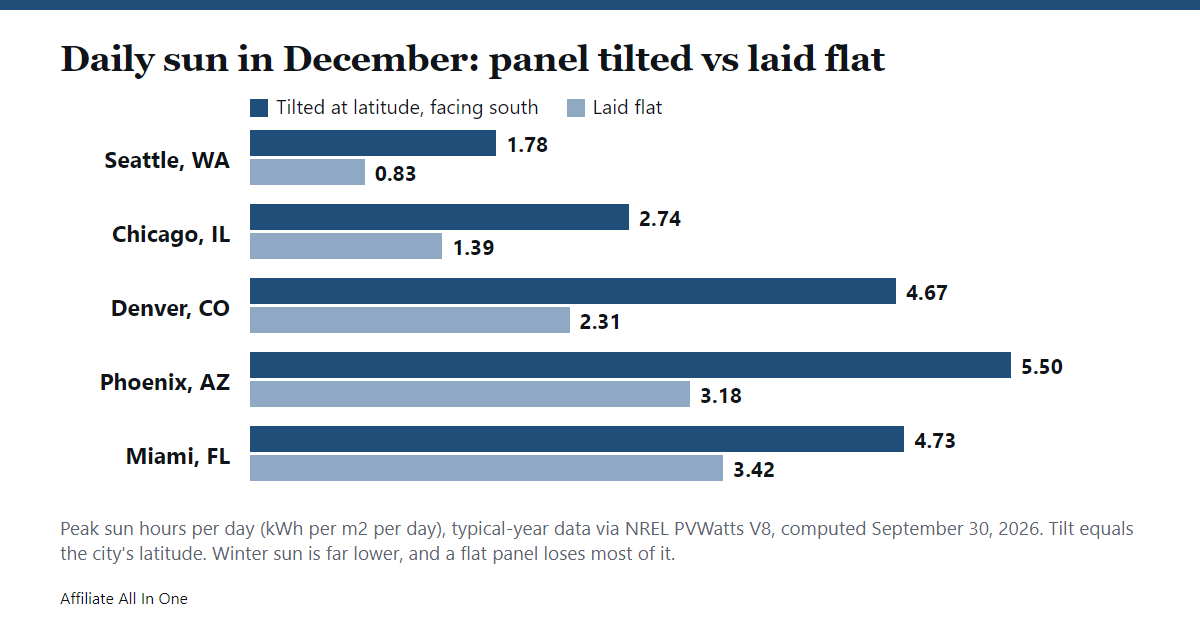
Three things stand out. First, latitude and climate matter: Phoenix beats Seattle in every column. Second, winter is the problem: Seattle’s tilted December figure is less than half its yearly average. Third, laying a panel flat costs the most in winter, while in June a flat panel actually collects more than a tilted one in all five cities (Denver: 7.38 flat versus 6.50 tilted). If you use a portable panel year-round, propping it up toward the sun in winter matters.
How many watts of panel you need
The rough daily energy from a panel is:
Daily Wh = panel watts × peak sun hours × (1 − losses)
For losses, NREL’s PVWatts version 5 manual (September 4, 2014) uses a default total system loss of 14% for a grid-connected system. It combines soiling (2%), shading (3%), mismatch (2%), wiring (2%), connections (0.5%), light-induced degradation (1.5%), nameplate rating (1%) and availability (3%), multiplied together rather than added. The inverter is modeled separately. We use 14%, or 0.86, as a starting point. It was not measured for portable kits, and a power station’s own charging and conversion losses come on top. We did not verify any product’s figure.
The table applies that formula to a 200 W panel. The size is a made-up example.
| City | December, laid flat | December, tilted | Annual average, tilted |
|---|---|---|---|
| Seattle, WA | 142 Wh | 306 Wh | 687 Wh |
| Chicago, IL | 240 Wh | 472 Wh | 791 Wh |
| Denver, CO | 397 Wh | 803 Wh | 1,011 Wh |
| Phoenix, AZ | 547 Wh | 946 Wh | 1,146 Wh |
| Miami, FL | 589 Wh | 813 Wh | 969 Wh |
Charging time follows from this. A 1,000 Wh battery (an example size) filled from empty by one 200 W panel would take about 1.3 days at Chicago’s annual-average sun, and about 7.0 days in Seattle in December with the panel laid flat. Both are before the station’s own losses, and cloudy days add more time.
How big a battery you need
For each device, energy per day is watts times hours used. These example loads use made-up numbers:
| Example device | Watts | Hours per day | Energy per day |
|---|---|---|---|
| Laptop | 60 W | 4 | 240 Wh |
| LED lights | 10 W | 5 | 50 Wh |
| Phone charging | 15 W | 2 | 30 Wh |
| Total | 320 Wh |
To refill that 320 Wh each day, the panel watts needed are 320 divided by (sun hours × 0.86). This is our own arithmetic:
| City | Annual average, tilted | December, tilted | December, laid flat |
|---|---|---|---|
| Seattle, WA | About 93 W | About 209 W | About 450 W |
| Chicago, IL | About 81 W | About 136 W | About 267 W |
| Denver, CO | About 63 W | About 80 W | About 161 W |
| Phoenix, AZ | About 56 W | About 68 W | About 117 W |
| Miami, FL | About 66 W | About 79 W | About 109 W |
The same 320 Wh a day needs about 81 W of panel at Chicago’s average sun, but about 450 W in Seattle in a laid-flat December. That is why the darkest month should set the panel size. The battery is separate: if you want to ride out cloudy days, it has to hold the energy you will use before the next good sun. Two cloudy days at 320 Wh a day means about 640 Wh in reserve, before margins.
Worked example: a weekend camping setup
Here is the same arithmetic for a camping trip. The loads are made-up examples, including the assumption that a small electric cooler runs 8 hours out of 24. Check the real watts on your own devices.
| Example device | Watts | Hours per day | Energy per day |
|---|---|---|---|
| LED lanterns | 10 W | 5 | 50 Wh |
| Phone charging | 15 W | 2 | 30 Wh |
| Small fan | 15 W | 6 | 90 Wh |
| Electric cooler | 40 W | 8 (of 24) | 320 Wh |
| Total | 490 Wh |
The panel watts needed to refill 490 Wh in a day are 490 divided by (sun hours × 0.86). We used the tilted-panel sun hours from the NREL data for July and October:
| City | July, tilted | October, tilted |
|---|---|---|
| Seattle, WA | About 101 W | About 172 W |
| Chicago, IL | About 93 W | About 135 W |
| Denver, CO | About 90 W | About 100 W |
| Phoenix, AZ | About 84 W | About 87 W |
| Miami, FL | About 98 W | About 105 W |
Two things follow. A summer trip needs far less panel than a fall trip in the cloudier cities. And the figures assume a panel facing due south at a fixed tilt in open sun, which a campsite under trees will not match, so shade pushes the real number up. For the battery, one day of these loads is 490 Wh; keeping one cloudy day in reserve would mean about 980 Wh before margins. These are our own calculations, not a product recommendation.
What to check on a spec sheet
- Battery capacity in Wh. This sets how much you can store.
- AC output: continuous and surge watts. The continuous rating must cover everything you run at once.
- Maximum solar input in watts. Panels rated above this may not help.
- Solar input voltage range and connector. Panels and station must match.
- The maker’s instructions on where and how to use it. We have not reviewed any product’s manual.
Frequently Asked Questions
What is a solar generator?
It is a portable power station, meaning a battery with outlets, used with solar panels that recharge it. It has no engine and burns no fuel. The EPA describes such battery-powered generators as able to connect to solar panels for recharging.
Is a solar generator different from a portable power station?
Our reading is that the power station is the battery-and-outlets box, and “solar generator” is the name used when it is paired with panels. The EPA lists “battery powered generators or power stations” together.
How long does it take to charge a power station with solar panels?
Divide the battery’s watt-hours by the daily energy your panels make (panel watts × sun hours × 0.86). In our example, a 1,000 Wh battery and one 200 W panel take about 1.3 days at Chicago’s average sun and about 7.0 days in Seattle in a laid-flat December, before the station’s own losses.
Can I use a solar generator indoors?
The EPA says battery-powered generators do not generate toxic fumes and can be used in indoor spaces, on balconies, or near doors, vents and windows. The panels still need sun, and you should follow the maker’s instructions for your model, which we have not reviewed.
How big a solar generator do I need for camping?
Add up your devices’ watt-hours for one day, then divide by sun hours × 0.86 to get panel watts. In our made-up example of 490 Wh a day, a July trip needs roughly 84 W to 101 W of panel across the five cities, and an October trip roughly 87 W to 172 W. See the worked example above, and check your own devices’ real watts.
How many solar panels do I need?
Work out your daily watt-hours, then divide by sun hours times 0.86 for your location and darkest month. The table above gives the result for a 320 Wh example. Check that the total stays within the station’s maximum solar input.
Sources
All pages were checked on September 30, 2026. NREL’s web addresses now use nlr.gov.
- EPA: Power outages and indoor air quality (last updated February 18, 2026)
- U.S. Department of Energy: Solar Radiation Basics
- NREL: PVWatts API V8 documentation, the source of the sun figures (typical-year NSRDB data, requested September 30, 2026)
- NREL: PVWatts Version 5 Manual (Aron P. Dobos, September 4, 2014), for the default 14% system loss
Spotted something out of date? See our corrections policy, or browse more Electronics guides.
Sources and last update
This article is written from official and primary sources, such as government agencies, standards bodies and manufacturer documentation, and is checked against them when it is updated. It is based on research, not hands-on testing. See how we research and our editorial policy.
Last updated: October 8, 2026